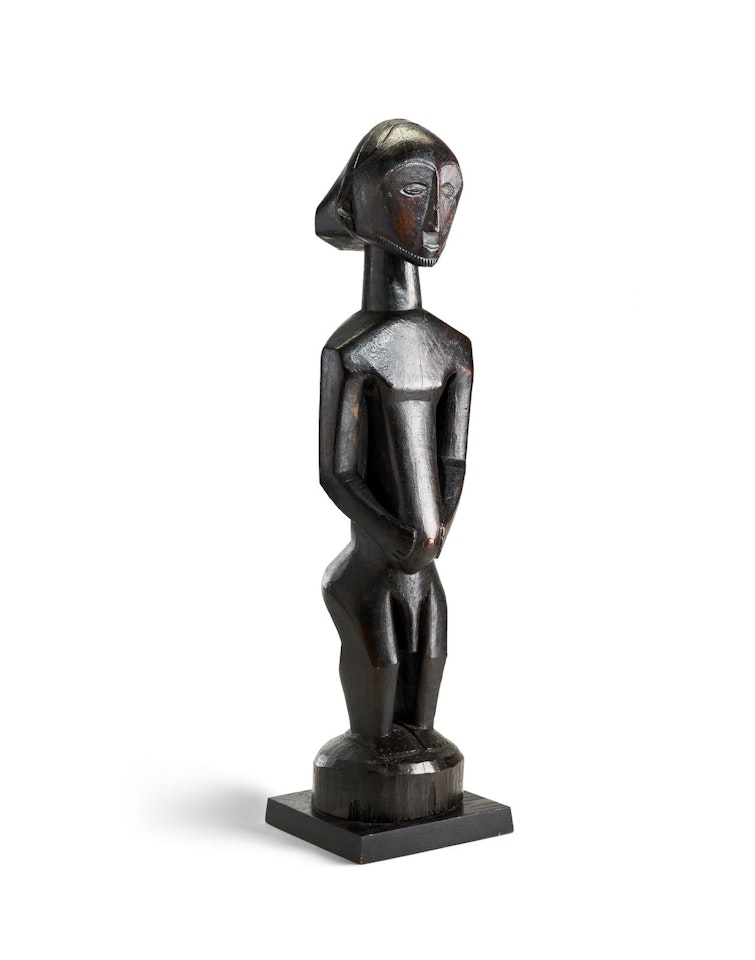
According to Niangi Batulukisi, "The Hemba artist is at the service of society. He receives commissions for sculptures of emblems of power or objects of prestige from lineage chiefs, clan chiefs, healers, diviners, and priests, as well as from the directors of voluntary associations. In the case of ancestral effigies, the person who commissions the work must furnish the name of the ancestor. They also must provide a person in the village who bears a physical resemblance to the ancestor (to be chosen as a model is an honor). The guardians of the ancestral effigies are the chiefs of lineages, great families, or clans.
Classic ancestral figures portray a masculine person with an ovoid-shaped face, a wide convex forehead, broad facial structure, and a pulled-back hairstyle in the form of a chignon (kibanda), with a cruciform motif. The great skill and creativity of the Hemba artist is evident in the stylized, hieratic demeanor of the body. These sculptures evoke the power and strength that the ancestor occupies in the Hemba social hierarchy. The head is disproportionately large compared to the legs. The abdomen protrudes, whereas the long truck in exaggerated by the curve of the shoulders and the rectilinear back. Its arms are detached from the body, the hands placed on either side of the navel. The short, flexed legs are usually fixed on a round base. The ancestral statue is devoid of tattoos and scarifications." (Mauer, Evan and Niangi Batulukisi, Spirits Embodied - The Art of the Congo, The Minneapolis Institute of Arts, 1999, p.126)